Pages

Thursday, 2 June 2011

The Needle-bed of a Knitting Machine


The needle-bed of a knitting machine is made up by the needles. As we said before, the needles can be all fixed on the same needle bar (picture 14) or can be driven individually in a grooved plate, according to the type of knitting machine. All knitting machines can be equipped with one or two needle-beds, according to the model.


Picture 14 - A needle bar with spring beard needle
                                     
                                   Picture 15 - The needle-bed of a flat knitting machine

The needle-bed of a knitting machine can be flat (picture 15) or circular (picture 16). It is made up of a steel body provided with grooves where the needles with hook and butt turned upward slide. The milled grooves guide the needles during the knitting process.

  Picture 16- The needle-bed of a circular knitting machine
The needle-bed is characterised by two elements:
- the operating width
- the gauge

The operating width is the maximum working area and varies according to the type of machine (picture 17): for example in a flat-bed machine the operating width is the distance between the first and the last needle while in circular knitting machines the operating width is the needle-bed diameter.

The gauge is the population of needles on a certain length of bed. The English Gauge is the number of needles included in an English inch, that is to say how many are included in 2.54 needle-bed centimetres. From a conceptual point of view, the English inch is measured from the centerline of a needle but usually it is the distance corresponding to 1 inch, measured from one side of the needle to the same side of another needle within 1 inch. For example: if we start from the right side of the first needle we will have to reach the right side of the last needle. The gauge refers always and only to one of the two needle-beds. The English gauge is indicated with a capital E and is used for all the weft knitting machines and warp knitting frames.

There are also other types of gauges used for other machines and specifically:
  1. The English Raschel Gauge for Raschel looms is indicated with the capital letters “ER” and refers to the number of needles included in 2 inches, that is to say in 5.08 centimetres;
  2. The GG Gauge is indicated with the capital letters GG and refers to the number of needles included in 1.5 inches, that is to say in 3.81 centimetres. This gauge is usedfor flat-bed full-fashioned machines and for English circular machines.
  3. French Gauge is indicated with the Gros symbol and refers to the number of needles included in 1.5 French inches, that is to say in 4.16 centimetres. It is used for loopwheel circular machines.
  Flat needle-bed width                        Circular needle-bed diameter


Sinker | Sinker Operations of Knitting Machine


Sinker
The sinker is the second primary knitting element. It is a thin metal plate with an individual or a collective action operating approximately at right angles from the hook side of the needle bed, between adjacent needles.

Sinkers capable of producing loop fabric are well known in the knitting industry. In such machines the sinkers generally include a blade having an upper edge which defines a lower knitting level and a nib having an upper edge which is at an upper knitting level. Long loops are formed at the upper knitting level of the sinkers with a loop yarn and a base yarn is knitted over the blade. The sinkers may be formed and their movement controlled to cause either the loop yarn to appear on one side of a fabric and the base yarn on the other or the loop yarn to appear on both sides.

In the past it has not been possible to producing loop cloth of ideal quality since loops would twist or coil making it difficult to finish a loop fabric into satisfactory velor. Furthermore loops which were supposed to appear on the front of a fabric would sometimes appear on the other side. The back of loop cloth was therefore apt to have objectionable loose protruding loops and double tuck stitches.

1=Butt,2=Butt breadth,3=Height of shank,4=Buldge,5=Neb,6=Length of neb,7=Throat angle,8=Sinker platform height,9=Breadth of lower shank,10=Clearance,11=Throat

    Fig: sinker.
Sinkers Operation
1. The held loop is positioned in the throat of the sinker when the sinker moves forward and the needle moves upward for clearing. The held loop is held by the throat and hence its movement along the needle is restricted.


2. The sinker remains at its forward position when the needle attains its clearing position.


3. The sinker retracts when the needle comes down after feeding. At this stage, due to sinkers retraction, fabric or held loop is eased out. Also the sinker belly supported the fabric or held loop and hence its movements along the needle is prevented.


4. Sinker remains in backward position and the needle descends to its lowest position drawing the new loop through the old one.


5. Before the needle ascends, the sinker moves forward to push the knitted fabric a little and to hold the old loop away from the head of the needle and to be in a position to control the fabric.


Basic Knitting Elements of a Circular Knitting Machine


NEEDLES
The needles are the most important stitch forming elements. They are displaced vertically up and down and are mounted into the tricks or cuts of the knitting cylinder.
There are three types of needles namely:
1. Latch needle
2. Spring bearded needle 
3. Compound needle.

We can divide a needle into three main parts:
A. the hook, which takes and retains the thread tube looped;
B. the hook opening and closing device, that allows the hook to alternatively take a new thread and release the previous one;
C. a system allowing the needle to move and form the loop.
 

1=Butt,2=Butt height,3=Back shank,4=Stem,5=Crimp,6=Groove,7=Cheek,8=Hook,9=Hook width,10=Latch,11=Rivet 

                                                                     Fig: Needle

Sinker
The sinker is the second primary knitting element. It is a thin metal plate with an individual or a collective action operating approximately at right angles from the hook side of the needle bed, between adjacent needles.
1=Butt,2=Butt breadth,3=Height of shank,4=Buldge,5=Neb,6=Length of neb,7=Throat angle,8=Sinker platform height,9=Breadth of lower shank,10=Clearance,11=Throat

       Fig: sinker.

CAMS
The knitting cams are hardened steels and they are the assembly of different cam plates so that a track for butt can be arranged. Each needle movement is obtained by means of cams acting on the needle butts.
The upward movement of the needle is obtained by the rising cams or clearing cams. The rising cam places the needle at a certain level as it approaches the yarn area. Cams controlling the downward movement of the needles are called stitch cams.

Fig: Cams

Wednesday, 1 June 2011

Cams | Types of Cams | Knitting Cams | Engineering Cams

Yarn | Classification of Yarns | Yarn Designation


Yarn is a product of substantial length and relatively small cross-section consisting of fibres or filaments with or without twist. It is the long fine structures capable of being assembled or interlaced into such textile products as woven and knitted fabrics, braids, ropes, and cords.
Yarn

Classification of Yarns:

1. Single Yarn.
a) Continuous Filament.
b) Spun Yarn. It can be two types. One is Homogeneous, another is Blended.
c) Modified Continuous Filament.

2. Multi-folded Yarn/ Ply Yarn.
3. Cabled Yarn.
4. Complex Yarn/ Core Spun Yarn
5. Fancy Yarn/ Novelty Yarn
6. Stretch Yarn
7. High Bulk Yarn

Yarn Designation:
The factor which are required to express yarn structure and properties wholly, are called yarn designation.
The factors of yarn designation are:-

1. Yarn Count / Linear Density.
2. No. of Filaments.
3. Fibre Components.
4. No. of components in folding.
5. Direction & amount of twist.


Weaving | Weaving Mechanism | Classification of Weaving Machines

Weaving:
The process of producing a fabric by interlacing warp and weft threads is known as weaving. The machine used for weaving is known as weaving machine or loom. Weaving is an art that has been practiced for thousands of years. The earliest application of weaving dates back to the Egyptian civilization. Over the years, both the process as well as the machine has undergone phenomenal changes. As of today, there is a wide range of looms being used, right from the simplest hand loom to the most sophisticated loom.


Classification of Weaving Machines:
Weaving machines are classified according to their filling insertion mechanism. The classification is as follows:
 
1. Shuttle
2. Shuttle-less

  • Projectile
  • Rapier
  • Air-Jet
  • Water-Jet
Shuttle Weaving
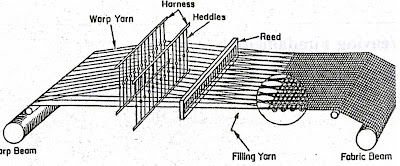
In shuttle weaving, a shuttle that traverses back and forth across the loom width, inserts the filling. Shuttles can be made of wood or plastic. Filling yarn is wound on the quill and the quill is placed in the shuttle. As the shuttle move across the loom, the filling yarn is unwound from the pirn and lay in the shed.

Fig: Basic Weaving Mechanism
Projectile Weaving
Projectile weaving machines use a projectile equipped with a gripper to insert the filling yarn across the machine. The gripper projectile draws the filling yarn into the shed. The Projectile glides through the shed in a rake- shaped guide. Braked in the receiving unit, the Projectile is then conveyed to its original position by a transport device installed under the shed.


Fig: Projectile Weaving
Rapier Weaving
In Rapier weaving, a flexible or rigid solid element, called rapier, is used to insert the filling yarn across the shed. The rapier head picks up the filling yarn and carries it through the shed. After reaching the destination, the rapier head returns empty to pick up the next filling yarn, which completes the cycle. A rapier performs a reciprocating motion.

Picture: Weft insertion by rapier

Rapier weaving machines can be of two types:

1. Single Rapier Machines: A single, rigid rapier is used in these machines. The rigid rapier is a metal or composite bar usually with a circular cross section. The rapier enters the shed from one side, picks up the tip of the filling yarn on the other side and passes it across the loom width while retracting. Therefore, a single rapier carries the yarn in one way only and half of the rapier movement is wasted. Also there is no yarn transfer since there is only one rapier. The single rapier’s length is equal to the width of the loom.

2. Double Rapier Machines: Two rapiers are used in these machines: one rapier, called the giver, takes the filling yarn from the yarn accumulator on one side of the loom, brings it to the center of the machine and transfers it to the second rapier which is called the taker. The taker retards and brings the filling yarn to the other side. Similar to the single rapier machines, only half of the rapier movements are used for filling insertion.

Air-Jet Weaving
The air jet weaving machines are the weaving machines with the highest weft insertion performance and are considered as the most productive in the manufacturing of light to medium weight fabrics, preferably made of cotton and certain man-made fibers (sheets, shirting fabrics, linings, taffetas and satins in staple yarns of man-made fibers); it has anyway to be pointed out that technically positive results are obtained at present also with heavy weight fabrics (denims) and that some manufacturers produce also machine models for terry production.


Fig: Air-Jet Weaving

These machines are the ideal solution for those who want to produce bulk quantities of customized fabric styles. The weaving widths range generally from 190 to 400 cm. As regards the multicolor weft carrier, up to 8 different wefts can be fed. It has however to be considered that the air jet weaving machines require a high energy consumption to prepare the compressed air and that this consumption rises definitely with increasing loom width and running speed. The reduction in the energy consumption is in fact one of the main concerns of the manufacturers, and builds for the user an important selection criterion.

Water-Jet Weaving
A water-jet weaving machine inserts the filling yarn by highly pressurized water. The relative velocity between the filling yarn and the water jet provides the attractive force. If there is no velocity difference, then there would be no tension on the yarn results in curling and snarling of the yarn. Water-jet weaving machine can only be used for hydrophobic fibers.

Fig: Water-Jet Weaving

Assumptions of an Ideal Yarn Geometry | Properties of Ideal Yarns


yarn
The following yarn properties should have a textile yarn if it is said as a ideal yarn-

1. The yarn in circular in cross-section and is uniform along its length.
2. Yarn is composed of concentric layers of different radial.
3. Each fibre follows a uniform helical path around one of the concentric cylinder so that its distance from yarn axis remains constant.
4. A fibre at the centre will follow a straight line of the axis.
5. The axis of circular cylinders coir sides with yarn axis.
6. The number of filaments or fibres crossing the unit area is constant; that is the density of packing. Fibres in the yarn are constant throughout the model.
7. Every filament in the yarn will have the same amount of twist per unit length.
8. The yarn consists of very large number of filaments.

If the above mentioned yarn properties is absent on any yarn than the yarn should not be allowed on weaving to make fabric. Because it will not be able to give you a perfect weaving combination where the warp and weft yarn’s parameter is mandatory to be maintained.