Pages

Showing posts with label Fabric Manufacturing. Show all posts

Sunday, 7 August 2011

Yarn Tensioners in Weaving | Types of Tensioning Device | Important Effects of Tensioning Device | Factors Influencing the Selection of Tensioners

Yarn Tensioners:
Yarn Tensioners are devices by the help of which tension is given to the yarn. This is an important device because it enables us to provide necessary tension to the yarn as it moves through the different parts of the mschine. It is specially used in spinning, weaving and knitting machine.
Yarn Tensioners
Types of tensioning device 
There are basically three types of method by which tension is applied to yarn. They are as follows:
  • Capstan method 
  • Additive method 
  • Combined method
Capstan Method
This is the simplest form of yarn tensioning device where the yarn is passed around posts where the tension on the yarn is provided from the friction between the posts and yarns.

This follows the classic law of:

Output tension = Input tension x eµθ


Additive method
In this method the yarn is passed through the middle of two surfaces in contact. The force is applied from above to give suitable tension to the yarn.

Combined method
The combined system is a combination of capstan and additive method. This device is a complicated system which on allows the addition of tension. We cannot decrease the tension with this device. It is seldom used.

Important effects of tensioning device 
If the tension is too high then
  • The yarn can be damaged 
  • The rate of yarn breakage will be high 
  • The elongation property of yarn will change
If the tension is too low then
  • It can lead to unstable or loose package formation which will cause problems during unwinding
  • Variation in yarn in different parts of a wound package will cause undesirable effects
For man made filament yarn improper tension will cause
  • Change in molecular structure 
  • Variation in colour shades
For staple or spun yarn too high tension will cause
  • Yarn breakage at thin places
Factors influencing the selection of Tensioners 
  • The device must be reliable to control uniform tension 
  • The device must be easily thread able 
  • It must not introduce or magnify tension variation 
  • It must not introduce variation in twist 
  • It must not be affected by wear 
  • It must be easily adjustable 
  • It must not be affected by oil and dirt 
  • It must not encourage dirt collection 
  • It must be easily cleanable 
  • The operating surface must be smooth 
  • It must be cheap
 

Yarn Clearer in Winding | Types of Yarn Clearer | Comprise Between Mechanical and Electronic Clearer

Yarn Clearer 
Yarn clearer is the device which is used to remove the following faults of yarn in order to increase the yarn quality and weaving efficiency.

Faults of yarn are as follows
  • Thick and thin places 
  • Slab and neps 
  • Loose fabric 
  • Foreign materials
Types of Yarn Clearer

There are two types of yarn clearer

1. Mechanical Type

a. Conventional blunt type
b. Serrated blade type

2. Electronic type

a. Capacitance type
b. Photo electric type

Comprise between mechanical and electronic clearer

• Electronic clearer are more sensitive than mechanical clearers
• In case of mechanical clearers there is abrasion between yarn and clearer parts but in case of electronic clearers there is no such abrasion
• Mechanical clearers do not prevent soft slab from escaping through clearer where as electronic type does not allow passing of any types of faults
• Mechanical type does not break the thin places and the length of the fault is not considered
• Mechanical clearer are simple and easy to maintain while the electronic clearers are costly and requires high standard of maintenance


Tuesday, 2 August 2011

What is Loom | Define Loom | Shuttle Loom | Shuttle less loom | Modern Loom | Classification of Modern Loom | Projectile Loom | Rapier Loom | Water Jet Loom | Air Jet Loom | Circular Loom

An apparatus for making fabric by weaving yarn or thread. A loom is a device used to weave cloth. The basic purpose of any loom is to hold the warp threads under tension to facilitate the interweaving of the weft threads. The precise shape of the loom and its mechanics may vary, but the basic function is the same.

Shuttle Loom: The shuttle loom is the oldest type of weaving loom which uses a shuttle which contains a bobbin of filling yarn that appears through a hole situated in the side. The shuttle is batted across the loom and during this process, it leaves a trail of the filling at the rate of about 110 to 225 picks per minute (ppm). Although very effective and versatile, the shuttle looms are slow and noisy. Also the shuttle sometimes leads to abrasion on the warp yarns and at other times causes thread breaks. As a result the machine has to be stopped for tying the broken yarns.

Classification of Modern Loom:

Shuttle less loom: Many kinds of shuttle less looms are used for weaving such as Projectile Looms; Rapier Looms; Water Jet Looms; and Air Jet Looms.

Projectile Loom: It is sometimes called missile loom as the picking action is done by a series of small bullet like projectiles which hold the weft yarn and carry it through the shed and then return empty. All the filling yarns are inserted from the same side of the loom. A special tucking device holds the ends of the wefts in place at the edge of the cloth to form the selvage. This loom needs smooth, uniform yarn which is properly sized in order to reduce friction. Projectile loom can produce up to 300 ppm and is less noisier then the shuttle loom.

Rapier Loom: Rapier loom comes in many types. Early models of it use one long rapier device that travels along the width of the loom to carry the weft from one side to the other. Another type of rapier loom has two rapiers, one on each side of the loom. They may be rigid, flexible or telescopic. One rapier feeds the weft halfway through the sheds of warp yarns to the arm on the other side, which reaches in and carries it across the rest of the way. Rapier looms are very efficient and their speed ranges from 200 to 260 ppm. These looms can manufacture a variety of fabrics ranging from muslin fabric to drapery fabrics and even upholstery fabrics.

Water Jet Loom: In it, a pre measured length of weft yarn is carried across the loom by a jet of water. These looms are very fast with speeds up to 600 ppm and very low noise. Also they don’t place much tension on the filling yarn. As the pick is tension less, very high quality of warp yarns are needed for efficient operation. Also, only yarns that are not readily absorbent can be used to make fabrics on water jet looms such as filament yarn of acetate, nylon, polyester, and glass. However, it can produce very high quality fabrics having great appearance and feel.

Air Jet Looms: In the air jet weaving looms, a jet of air is used to propel the weft yarn through the shed at speeds of up to 600 ppm. Uniform weft yarns are needed to make fabrics on this loom. Also heavier yarns are suitable for air jet looms as the lighter fabrics are very difficult to control through shed. However, too heavy yarns also can’t be carried across the loom by air jet. In spite of these limitations, air jet loom can produce a wide variety of fabrics.

Circular Looms: These looms are particularly used for making tubular fabrics rather than flat fabrics. A shuttle device in it circulates the weft in a shed formed around the machine. A circular loom is primarily used for bagging material.


Thursday, 2 June 2011

Principle of Negative Tappet Shedding Mechanism

Principle
A tappet is given a rotary motion so that it depresses a follower and a lever, known respectively as the anti-friction bowl and the treadle arrangement, by means of which the heald shaft is operated.

Construction
Figure shows a negative tappet shedding mechanism. A pair of tappets A and B are fixed to the bottom shaft C at 180 degrees to each other. Two treadle levers D and E are connected to the loom back-rail by a bracket F.

The bracket acts as a fulcrum for the levers. The two treadles have teeth to carry the lamb rods G and H respectively. Two heald shafts J and K are connected to the lamb rods. A top reversing roller shaft Q carries two rollers of different diameters. The roller of small diameter N is connected to a leather strap L to which the front heald shaft J is connected. The roller P of large diameter is connected to a leather strap M to which the back heald shaft K is connected. The tappets A and B touch the anti-friction bowls or followers R and S respectively, which are fixed to the treadle levers.
Figure : Negative tappet shedding mechanism
The heald shafts have heald eyes T and U through which the war p threads pass X is the war p sheet and Y is the cloth. The odd ends are passed through one heald shaft while the even ends are passed through the other heald shaft.

Working Process:
When the bottom shaft is rotated in the clockwise direction as shown in the figure, the tappets are also rotated. The tappet will depress the anti-friction bowl and the treadle. Being fulcrumed at one end, the front portion of the treadle moves down. This action is transferred to the lamb rod, the heald shaft and the leather strap. So one heald shaft is lowered and the threads connected to this heald shaft are lowered and form the bottom layer of the shed.

The leather straps attached to the reversing rollers are connected in opposite directions, i.e. when leather strap is pulled down, it is unwound from its roller. The shaft therefore rotates in the clockwise direction and the other leather strap is wound on to its roller. The heald shaft is raised and therefore the lamb rod and treadle lever are also raised. The threads connected to the heald shaft are also raised and form the top layer of the shed.

For the next shed, the other tappet works with the other set of bowl, treadle, lamb rod, heald shaft, strap and roller and the other heald shaft is lowered. The first heald shaft is raised by the top reversing rollers, and the positions of the healds shafts are thus interchanged. Thus, for one rotation of the bottom shaft, two sheds are formed.

In this type of tappet shedding therefore, one tappet depresses the concerned treadle and the corresponding heald shaft is lowered. But the other heald shaft is raised by means of the top reversing rollers. So this type of shedding mechanism is known as “negative tappet shedding mechanism”

Timings and Settings:
  1. Turn the crank to the top centre position.
  2. Fix the anti-friction bowls to the treadle levers; they should move freely in the slots.
  3. Fix the treadle levers with a bracket to the back rail of the loom.
  4. Set the grid and grid bracket to the front rail of the loom in the slots of the grid.
  5. Make sure that the tappet with the lower throw is fixed to the bottom shaft at the starting handle side.
  6. Fix the top reversing rollers to the top reversing roller shaft to be equidistant from the ends and at the same time ensure that the connecting screws of the rollers are symmetrical about the central axis of the shaft when the heald shafts are at the same level. The roller of smaller diameter is always connected to front heald shaft.
  7. The heald shafts are connected to the top reversing rollers by means of cords and leather straps. The leather straps are connected to the rollers, such that when one of them winds on its roller the other strap unwinds from its roller and vice versa.
  8. Lamb rods are connected to the heald shafts by cords.
  9. Adjust the tappets on the bottom shaft and make sure of the following points :
  • The tappet with a bigger throw should be connected to the back heald shaft.
  • The bowls should have perfect contact with the tappet surfaces.
  • The treadles should be at the same level and parallel to each other at the top centre position.
Heald shafts : The hook of the lamb rod of the front heald shaft should be connected to the first notch of the treadle lever while that of the back heald shaft should be connected to the third notch. If the depth of shed is altered, the connections of the hooks to the treadle levers can be changed.

Points to be Observed:
  1. Turn the crank shaft through two revolutions and make sure that the bowls are always in contact with the tappets.
  2. The heald shafts should not touch the side frames or the sley.
  3. Turn the crank shaft to the bottom centre and check the size of shed. The bottom line of warp sheet or the heald eyes of the lowered heald shaft should have a clearance of 1 mm from the race board and the top.
 

Wednesday, 1 June 2011

Weaving | Weaving Mechanism | Classification of Weaving Machines

Weaving:
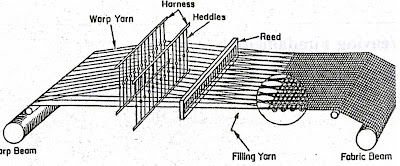
The process of producing a fabric by interlacing warp and weft threads is known as weaving. The machine used for weaving is known as weaving machine or loom. Weaving is an art that has been practiced for thousands of years. The earliest application of weaving dates back to the Egyptian civilization. Over the years, both the process as well as the machine has undergone phenomenal changes. As of today, there is a wide range of looms being used, right from the simplest hand loom to the most sophisticated loom.


Classification of Weaving Machines:
Weaving machines are classified according to their filling insertion mechanism. The classification is as follows:
 
1. Shuttle
2. Shuttle-less

  • Projectile
  • Rapier
  • Air-Jet
  • Water-Jet
Shuttle Weaving
In shuttle weaving, a shuttle that traverses back and forth across the loom width, inserts the filling. Shuttles can be made of wood or plastic. Filling yarn is wound on the quill and the quill is placed in the shuttle. As the shuttle move across the loom, the filling yarn is unwound from the pirn and lay in the shed.

Fig: Basic Weaving Mechanism
Projectile Weaving
Projectile weaving machines use a projectile equipped with a gripper to insert the filling yarn across the machine. The gripper projectile draws the filling yarn into the shed. The Projectile glides through the shed in a rake- shaped guide. Braked in the receiving unit, the Projectile is then conveyed to its original position by a transport device installed under the shed.


Fig: Projectile Weaving
Rapier Weaving
In Rapier weaving, a flexible or rigid solid element, called rapier, is used to insert the filling yarn across the shed. The rapier head picks up the filling yarn and carries it through the shed. After reaching the destination, the rapier head returns empty to pick up the next filling yarn, which completes the cycle. A rapier performs a reciprocating motion.

Picture: Weft insertion by rapier

Rapier weaving machines can be of two types:

1. Single Rapier Machines: A single, rigid rapier is used in these machines. The rigid rapier is a metal or composite bar usually with a circular cross section. The rapier enters the shed from one side, picks up the tip of the filling yarn on the other side and passes it across the loom width while retracting. Therefore, a single rapier carries the yarn in one way only and half of the rapier movement is wasted. Also there is no yarn transfer since there is only one rapier. The single rapier’s length is equal to the width of the loom.

2. Double Rapier Machines: Two rapiers are used in these machines: one rapier, called the giver, takes the filling yarn from the yarn accumulator on one side of the loom, brings it to the center of the machine and transfers it to the second rapier which is called the taker. The taker retards and brings the filling yarn to the other side. Similar to the single rapier machines, only half of the rapier movements are used for filling insertion.

Air-Jet Weaving
The air jet weaving machines are the weaving machines with the highest weft insertion performance and are considered as the most productive in the manufacturing of light to medium weight fabrics, preferably made of cotton and certain man-made fibers (sheets, shirting fabrics, linings, taffetas and satins in staple yarns of man-made fibers); it has anyway to be pointed out that technically positive results are obtained at present also with heavy weight fabrics (denims) and that some manufacturers produce also machine models for terry production.


Fig: Air-Jet Weaving

These machines are the ideal solution for those who want to produce bulk quantities of customized fabric styles. The weaving widths range generally from 190 to 400 cm. As regards the multicolor weft carrier, up to 8 different wefts can be fed. It has however to be considered that the air jet weaving machines require a high energy consumption to prepare the compressed air and that this consumption rises definitely with increasing loom width and running speed. The reduction in the energy consumption is in fact one of the main concerns of the manufacturers, and builds for the user an important selection criterion.

Water-Jet Weaving
A water-jet weaving machine inserts the filling yarn by highly pressurized water. The relative velocity between the filling yarn and the water jet provides the attractive force. If there is no velocity difference, then there would be no tension on the yarn results in curling and snarling of the yarn. Water-jet weaving machine can only be used for hydrophobic fibers.

Fig: Water-Jet Weaving